The whole “execution eats strategy for breakfast” assertion is pointless and let me tell you why. When you dig into why people say this, you eventually get to the crux of it, which is that good execution means you learn faster and can pivot your strategy. That’s just being lean. It’s a truism. There isn’t a universe where “learning slower is better than learning faster.” Does this really add value? I fail to see how it does. It’s redundant.
It has one big assumption in there: that there is a feedback loop between strategy setting and execution in the organisation. How many people work in a company where there is little to no feedback loop between strategy setting and execution? I would guess it is actually the majority of people. Strategy is often set by people far from those doing execution. And often, when things don’t work out and feedback on the strategy is attempted, the response is inevitably, “We just didn’t execute well enough.” It’s inconceivable that the strategy might in fact be the problem.
I’ve worked in teams and companies with brilliant execution and a complete vacuum of — or incorrect — strategy. Those products and companies have since failed. They would surely have benefitted from improved strategy even at the cost of worse execution.
Perhaps it’s telling that you rarely hear this assertion from individual contributors, or rather non-strategy-setters. Instead — speaking from experience — they are often crying out for a coherent and clear strategy, or sometimes just any strategy at all, so they can direct their efforts effectively.
Two biases at play
Self-serving bias. Do you think strategy setters — often senior leadership — are likely to admit that their strategy was incorrect? Of course not. It must be the execution. Setting a strategy is, unfortunately and often incorrectly, high-stakes politically, as changes to it are seen as a failure.
Availability heuristic. It is much easier to evaluate execution than strategy, so that’s what people naturally gravitate towards doing. It’s very hard — and in fact requires somewhat decent execution — to gather sufficient inputs to evaluate the strategy sufficiently and objectively.
On top of all this, strategy and execution are inextricably linked. There is barely an air gap between them (at least when done moderately well).
So what does the phrase actually say?
Coming back to the original assertion, all you get when you unpack it is:
- Learning faster is better than learning slower
- There should be a working feedback loop between strategy and execution
Both of those are truisms. Therefore, the assertion is pointless.
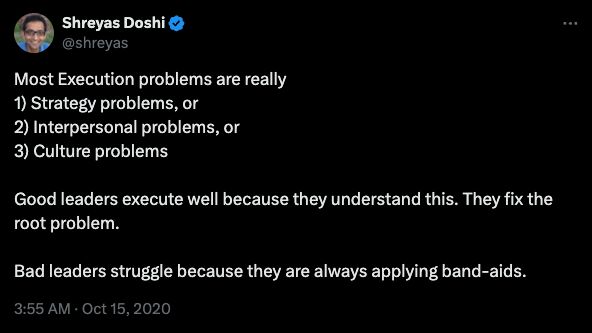
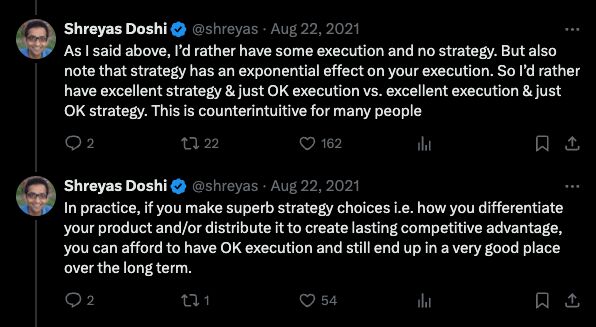
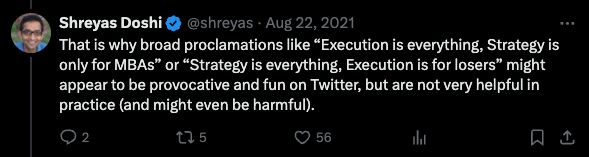
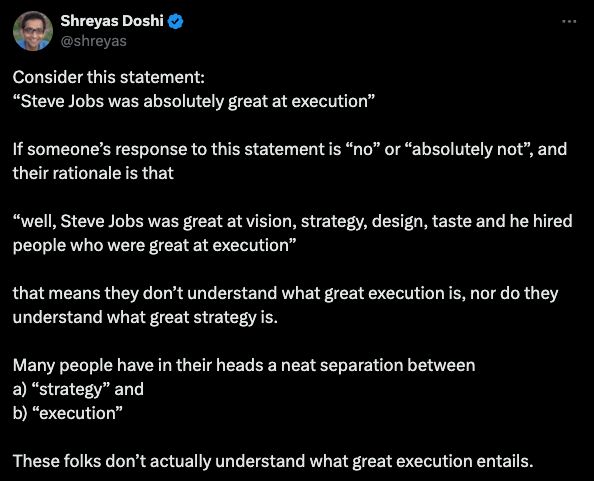
If you want a more nuanced take, my man Shreyas Doshi has some bangers. A few of his best, screenshotted below.